Monday, 11 February 2013

Trail Blazer or Path Finder – Which are you?


I have noticed that some people won’t venture toward new goals unless the path is clear for them whilst others relish the challenge of creating the path for others to follow. What must Change Leaders do to stop the paralysis of the former who are reluctant to start their journey unless they can see their destination straight in front of them?

I have learned that if you give someone 52 things to do they will sit in awe of them and do nothing. However if you give the same person one thing to do each week, and be damn sure that they must do it then quickly you gather momentum because there are far fewer reasons for not doing one thing than there are for not progressing 52.


It does sometimes surprise me that people can’t take 52 things and break them into bite-size pieces for themselves but instead rely upon leaders to create the path and managers to lead them down it, but I guess that’s why we have personal trainers, directions on food packets and all sorts of other things to prompt and guide us through the maze of information and possibilities that confuse and distract us.


I once thought that giving some templates and guidance was like giving a map and compass and would give people the skills, confidence and ability to set their own path, but I suspect that not everyone likes to be a self-reliant back-packer. Some prefer the five-star comfort of knowing that everything has been done for them and the only thing that they need to consider is what happens next.

The challenge of leadership therefore is to recognize these two very different travelers and give each a role that fits their talents and ensures their progress toward their new destination. If you can blaze a trail and create innovation and creativity, whilst also setting a path for others to easily follow then you are probably on the right track to be a Change Leader.


Tim Rogers

Founder ciChange
timrogers@ciChange.org
http://www.linkedin.com/groups/CI-Change-4301853

ciChange seminar and networking events for 2013 sponsored by Total Solutions Group http://www.tsgi.co/


Saturday, 9 February 2013

The first of 3 Top Tips to help you influence change and break down resistance.


It's human nature to shun change. Millions of years of evolution have taught us to constantly seek and protect what we need to survive and reject anything that may threaten us. Freud called it the 'Pleasure principle'; seeking comfort and avoiding pain or suffering. So, why would we want to change something that we believe has served us well?


This theory may have worked well for millions of years and of course still does to an extent. However, in a blink of planet earth's 'eye', the way we live our lives has changed beyond recognition and today more than ever we need to be receptive to change and be able to readily adapt. We are no longer the hunter/ gatherers that we were for millions of years.

A clearly defined everyday example of resistance to change could be the number of people who do not and will not 'use' the internet because they claim it is no benefit and why should they start now? Why indeed....?

If we accept the above, and the need to change, then we need to equip ourselves with the tools that can assist in promoting that change.

Some of you may have heard of Neuro Linguistic Programming (NLP). It was developed in the 1970's and is rapidly gaining recognition globally. NLP explores the relationships between how we think (neuro), how we communicate (linguistic) and our patterns of behaviour and emotion (programmes).
By studying and learning from these relationships people can effectively transform the way they traditionally think and act, adopting new, far more successful models of human excellence. (This activity is called modelling and is a key feature that distinguishes NLP from psychology). In effect, NLP is a powerful change management tool that transforms the way people think and act to have the greatest impact both professionally and personally. That’s why NLP is one of the most powerful skills used in business management, psychology, sales, sports coaching and all forms of personal development and engagement.
Over the next few blogs I will suggest some key NLP tools that could prove useful in the context of this forum starting with..

Representational systems

Which of our senses do we best relate to? Most people have a preference or selection of preferences. For example, if you were asked 'Do you see where I'm coming from'? Could imply the person asking the question may have vision as a preferred sense (if only in this scenario).
 
Here's a link to a simple 5 point test to gauge your preferred Rep system


http://www.transformdestiny.com/nlp-guide/nlp-representational-systems-preference-test.asp


Remember – NLP is not science, it is a pragmatic school of thought that can and may give you an insight as to how others 'tick', create rapport and help promote change. Why not give it a go?

Greg Fisher
February 2013

Neuro Linguistic Programming (NLP) is a big but fascinating subject. Greg’s introduction to it and examples from the NLP ‘tool-kit’ will be really valuable to anyone interested in engaging people and managing resistance to change.

ciChange is planning its’ activities for 2013. If you are interested in finding out more about Individual and Team communication and how tools like NLP can be used to support change in behaviours please offer feedback via email or Linked-In.

Tim Rogers

Founder ciChange
timrogers@ciChange.org
http://www.linkedin.com/groups/CI-Change-4301853

ciChange seminar and networking events for 2013 sponsored by Total Solutions Group http://www.tsgi.co/


Thursday, 24 January 2013

Living the dream – is it a good time to contemplate changing employment status?


Living the dream – is it a good time to contemplate changing employment status?
By Ian Ronayne

At some point in our working lives, many of us will dream of being our own boss. It may be a long held ambition or a spur of the moment consideration, perhaps following yet another tactless managerial dressing down for some trivial incident or after we find ourselves labouring on in the office long after everyone else has departed. Yet whatever the catalyst, for most full time employees the dream of a what seems to be a more fulfilling working life will remain just that – a dream. And that’s absolutely fine.

For others, however, the self-employment option will move from dream to opportunity (or is it threat?). Maybe it’s through personal choice - I really don’t want to work for someone else anymore and I can see the chance to do something for myself. Or maybe it’s through redundancy - I don’t really want to work for myself, but personal circumstances mean it’s going to be difficult to get back into gainful full time employment. I suspect the latter is a very real and very disconcerting scenario for more than a few people in Jersey today.

But whether through design or fortune, is now a good time to try turning that opportunity into self-employment reality? And if it is, how easy is it for former full time employees to change to self-employed status?  

Thinking about the former question, it seems logical that the same factors pushing full time employees out of organisations are creating professional skills gaps that need filling, although not on a full time basis of course. Spare internal resource capacity has diminished but the work still needs doing. Contracting someone in – for a few months, a few weeks, a few days or even a few hours – may be an attractive choice for many organisations, so the opportunities must be there for the flexible small business or sole trading freelancer.

But if the opportunity exists, is it easy to move from full time employee to self-employed entrepreneur in order to take advantage of it? The answer, in my experience, is yes … and no.
Let’s deal with the “yes” first. I say yes because there are plenty of States run or sponsored organisations offering advice, leaflets and websites on how to become self-employed. They are able to explain technical details such company structure and social security contributions, and offer templates for business cases, marketing plans, cash flow forecasts and the like.

But here comes the “no”. While this may be interesting information, it does little to prepare people for the self-employment life, or help them turn a dream into the reality of finding fulfilling work that offers a degree of security and a decent living. And I think this is what many people who would work for themselves are looking for. Ok, there are those who want to start their own business in order to become the next Mark Zuckerburg or Alan Sugar, but for many others it’s a lifestyle career choice. Having turned our back on the full time corporate world, the thought of creating another of our own is not particularly desirable. 

So if official channels don’t offer much, where can would-be self-employed find help to get them started. I think the answer lies in speaking to others who have gone before them. Glean whatever hints and tips are available, and learn what works and what doesn’t. Really try to understand the demands and stresses of working for yourself, as well as the benefits and rewards. Wherever possible, use the acquired knowledge of others to assess your skillset against the market demand, identifying what you have to sell and – very importantly - how much others will pay for it.  

Where to find this information? Well unfortunately it’s not straightforward. While plenty of forums and networking clubs exist locally, none is dedicated to the self-employment world, and therefore meeting the right people is something of a hit and miss affair. A pipedream would be to see this addressed in 2013, so that more can turn their self-employment dreams into reality.  

Ian Ronayne
January 2013

ciChange is interested in helping [c]orporate and [i]ndividual change – c.i. Change and would be interested in workshops, seminars, blogs or any support that might be offered to help small or start-up businesses. If you are a small or start-up businesses looking for support or a professional, trainer or mentor able to provide support please contact me and we can see if we can set-up a suitable event.

We would also be interested in using www.ciChange.org to make information available, including possible links to JerseyBusiness (http://www.jerseybusiness.je/get-going) whose mandate includes to support business growth in Jersey.

Tim Rogers
Founder ciChange


Monday, 31 December 2012

How to achieve your mission for 2013

Happy New Year

It is at about this time of year we think about New Year’s resolutions, new beginnings, and change.
So it is timely to do a seasonal announcement and think ahead for 2013 and what changes we want to bring into our lives, our businesses and ourselves.

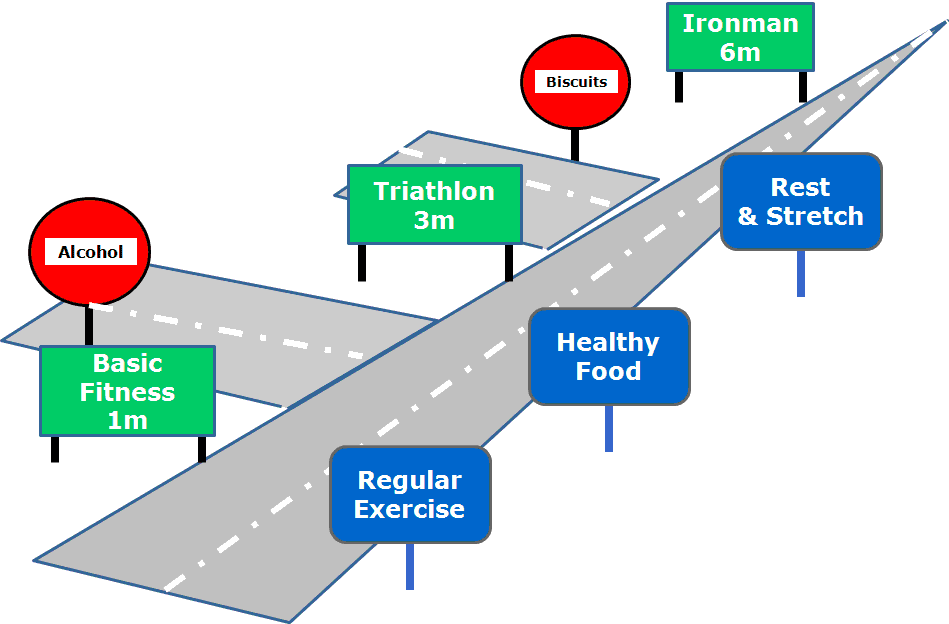
I’ve been reading Bradley Wiggins’ book My Time which has reinforced in my mind my ideas about Managing Change and what it takes to achieve successful and sustainable change.

I’ve seen lots of celebrity challenges and talent competitions and they all seem to say something like “I’d do anything for …..” The idea is that they would be prepared to do something in the future in return for a guarantee of success.

It seems to me however that athletic success is often about what you are prepared to give-up, compromise, or sacrifice whether that is time, money, food, alcohol, friends or family. There is a price to be paid for the journey and the rewards only come after the sacrifice, the effort and the journey is complete.

For example: There is less gained by doing more exercise if you are not prepared to change a bad diet.

I believe that real change can only come when both approaches are taken.  “I’m prepared to sacrifice…” demands immediate action to abandon bad behaviours and restraining factors and “I would do anything for…” sets the ground for new behaviours and attitudes.

The challenge for Change Managers and Leaders must be to harness the skills, talent, drive, passion and enthusiasm of the person or people and direct that to a unifying and shared goal.

Motivation is the fuel for change, and a unifying and shared goal offers a direction, but we need signposts and milestones to keep us on course. Being clear about the sacrifices avoid U-turns or subversion and reminders of our commitment in terms of behaviours and milestones keeps us moving toward the goal.

So with the New Year almost upon us now is the time to be your own Change Agent and think about abandoning bad behaviours and restraining factors, and which new behaviours and attitudes to adopt. Then write down the signposts and milestones for your journey. Perhaps put them on the fridge door, or by the front door, maybe in your diary or your screen-saver.  Make the plan big, bold, and simple.

Most significantly make the destination something really worth 365 days effort!

Tuesday, 18 December 2012

Context is everything: Would you recognize the talent in an unexpected context?

A man sat at a metro station in Washington DC and started to play the violin; it was a cold January morning. He played six Bach pieces for about 45 minutes. During that time, since it was rush hour, it was calculated that 1,100 people went through the station, most of them on their way to work.

Three minutes went by, and a middle aged man noticed there was musician playing. He slowed his pace, and stopped for a few seconds, and then hurried up to meet his schedule.


A minute later, the violinist received his first dollar tip: a woman threw the money in the till and without stopping, and continued to walk.

A few minutes later, someone leaned against the wall to listen to him, but the man looked at his watch and started to walk again. Clearly he was late for work.

The one who paid the most attention was a 3 year old boy. His mother tagged him along, hurried, but the kid stopped to look at the violinist. Finally, the mother pushed hard, and the child continued to walk, turning his head all the time. This action was repeated by several other children. All the parents, without exception, forced them to move on.

In the 45 minutes the musician played, only 6 people stopped and stayed for a while. About 20 gave him money, but continued to walk their normal pace. He collected $32. When he finished playing and silence took over, no one noticed it. No one applauded, nor was there any recognition.

No one knew this, but the violinist was Joshua Bell, one of the most talented musicians in the world. He had just played one of the most intricate pieces ever written, on a violin worth $3.5 million dollars.

Two days before his playing in the subway, Joshua Bell sold out at a theater in Boston where the seats averaged $100.

This is a real story. Joshua Bell playing incognito in the metro station was organized by the Washington Post as part of a social experiment about perception, taste, and priorities of people. The outlines were: in a commonplace environment at an inappropriate hour: Do we perceive beauty? Do we stop to appreciate it? Do we recognize the talent in an unexpected context?

One of the possible conclusions from this experience could be:

If we do not have a moment to stop and listen to one of the best musicians in the world playing the best music ever written, how many other things are we missing?" By: Josh Nonnenmoc

Do you suffer from Low Frustration Tolerance?


The Problem

People receive more helpful advice and information than ever before, in ever more clever, entertaining and effective ways about how to live longer, healthier, happier and more productive lives.  Yet we still have way too many people starting and continuing to behave in unhealthy, self-defeating, and sometimes even self-destructive ways, when faced with change. 

The Cause

People start and continue to behave in unhealthy, self-defeating ways because it serves a purpose. Behaviour of any kind is always goal-orientated.  Ideally, all our energy and effort would go toward reaching those goals we all have like living longer, healthier and happier lives, having good relationships with others, being successful at whatever we do, and having more control over our own destiny. But no one does that perfectly, or all the time.  Unfortunately, people often have "mistaken" goals that  get them off course. A very common mistaken goal is to try to temporarily withdraw from, or avoid unpleasant life events and get relief from the emotions that often go with them. So many unhealthy behaviours have that exact "mistaken" goal.

A large part of what gives rise to such "mistaken" goals, and purpose to unhealthy, self-defeating behaviour is that people generate a dysfunctional amount of emotion in the form of anger, anxiety, depression, shame, guilt, loneliness and even boredom.

Growing up people  are regularly told "you should be ashamed of yourself". No one likes being constantly reminded of what they do wrong. Generating a dysfunctional amount of emotion can impair peoples' readiness, willingness and ability to learn, and sabotage their performance. It can give purpose to unhealthy, self-defeating behaviour that only impairs such things even further.

People of all ages often don't do things they could to make their lives better because they generate   Low Frustration Tolerance for doing things they don't like.  Many underachieve because they suffer from Low Frustration Tolerance.

A dysfunctional amount of emotion causes people to react to life instead of respond to it. It makes them less response-ABLE.  It makes it harder for them to access and act on advice and information.

The Solution

Emotional management is considered the first and most important of all life skills people must master to be as functional as they can be. Teaching people of any age the simple but important life skills noted earlier can give them truly effective emotional management

Truly effective emotional management is often a missing ingredient in most wellness programs started by companies.  Much of what participants are taught ends up just being mere "band aid" approaches to the problem of generating a dysfunctional amount of emotion.

There are many ways to temporarily feel better. Some are healthy, many are not. Students and employees are sometimes taught some of the common healthy ways to temporarily make themselves feel better (i.e.Yoga, meditation, relaxation, biofeedback) or encouraged to vent.  However, there's a difference between temporarily feeling better and getting better.

Getting better means to reduce the overall frequency, intensity and duration of emotions like anger, anxiety, depression, etc. The only way to GET better is for people to change the way they think.

That's why it's much better for all concerned if people can learn to self-evaluate their own thoughts,
feelings and actions.  They can do so by asking some simple questions of themselves:

1)      What do I really want?  How do I really want to feel?
2)      How's it working for me to think, feel, say and do what I do now?
3)      Does the way I think or look at things allow me to feel the way I'd really like to?  Does what I think, feel, say and do allow me to get what I really want ?
4)      Does it make my life better or worse to think, feel, say and do what I do now?
5)      If I keep thinking what I do now, and looking at things the way I do, will it be easier or harder to feel the way I want to in the future?  If I keep thinking, feeling, saying and doing what I do now, will it be easier or harder to get what I really want in the future?


Acknowledgement to Ray Mathis, Adjunct Professor, St. Xavier University/International Renewal Institute

Friday, 7 December 2012

It’s what you don’t do that creates capacity for greatness

In any moment of decision, the best thing you can do is the right thing and the next best thing is the wrong thing-the worst thing you can do is nothing.-Theodore Roosevelt

Richard G. Stieglitz recently argued that at the end of the day, only action produces results. Building relationships, developing others, and making decisions lead to more effective actions; but it is the actions of you and your team along with the outcomes they produce that will build your reputation as a great leader.

My own experience is that sometimes pausing to reflect, thinking before doing, planning before action or more specifically not taking action is sometimes the key to success. You can often remedy inaction with action, but you cannot do the opposite.

Great Leadership Action (and Non-Action)
1.    Choose action or inaction wisely. In the words of Kenny Rodgers.. Know when to hold’em, know when to fold ‘em.
2.    Make teamwork a priority, encourage challenge and consensus rather than simple compliance. Another favourite quote.. None of us is smarter than all of us!
3.    Up-front conversations are better than costly consequences and wasted time and effort. It’s possibly better to ask What if? than Why?
4.    Ask staff and customers if they understand you mission, vision, goals or intentions. If their answers are accurate, congratulate yourself. If they are not, improve your communications.
5.    Put your effort to support, reward, motivate and inspire the people who create and deliver the products, and they will put their passion into what is delivered to your customers.
6.    Encourage risk taking and learning. Push your people into the uncomfortable learning zone and coach them to higher levels of success as part of the quality process.
7.    Confirm alignment. Get team-members to confirm team goals and their roles toward expected outcomes and benefits.
8.    Get comfortable with silence. Silence can be the prelude to a big decision or decisive action. Use silence in your conversations as thinking and reflecting time.

My advice to leaders..
It’s what you do that makes you great, it’s what you don’t do that creates capacity for those actions. – Tim HJ Rogers

With acknowledgement to Richard G. Stieglitz for some of the ideas in this blog.

CULTURE OR DATA – WHICH IS MORE IMPORTANT?

CULTURE OR DATA – WHICH IS MORE IMPORTANT? In a previous posting I noted that the book The Black Swan: The Impact of the Highly Improb...